
Investors receive pay-offs from their Multi-family Assets in two ways:
1 Cash flow disbursed quarterly.
2 Capital gains and equity that will be distributed when the property is sold in 3-5 years.

- With Ascendant Investments, LLC, investors are seen as preferred investors and are paid first from all revenue. 60% of all Cash Flow and Equity is distributed among investors. Actual dollar amounts and ownership splits will vary, depending on each specific deal and the amount contributed from individual investors. In some instances, Ascendant Investments, LLC may take less cash flow and receive more equity at sale.
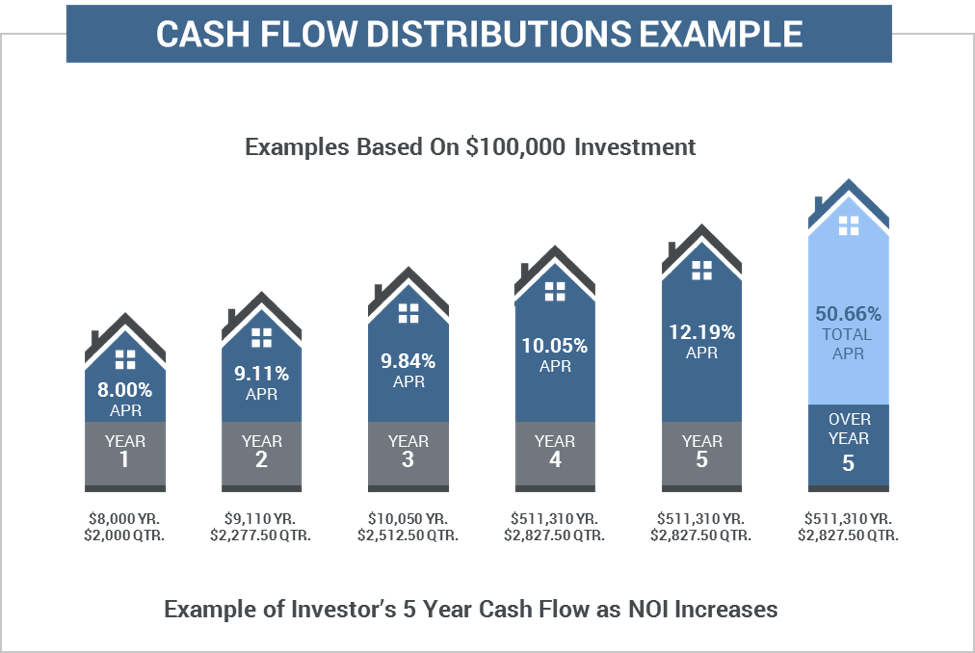
- The example below will demonstrate the kind of distributions and returns an investor could see from $100,000 invested with Ascendant Investments, LLC. Each diagram depicts the projected returns that the investor would make each year. Notice that cash flow increased each year as the Net Operating Income is improved.
Note: The above figures are only an example. Actual returns will vary based on each property.
In the above illustration, $100,000 has been invested. As depicted, increased NOI boosts cash flow each year, resulting in higher distributions each quarter. The final figures on the far right demonstrate the total projected cash flow after 5 years.
Investors will also see significant returns from the equity after the property is sold. Increased NOI each year not only enhances cash flow, but also builds equity. Investors will see their equity distributions once the property is sold approximately 3-5 years after the investment property is purchased.

Note: The above figures are only an example. Actual returns will vary based on each property.
Following the previous example, here we see how equity increases from a $100,000 investment. As mentioned previously, investors will not see equity distributions until the property is sold 3-5 years after its purchase. This diagram demonstrates the building effect on equity from improved NOI and mortgage pay down each year. Figures on the far right illustrate the total projected equity payout to the investor when the asset is sold after 5 years.
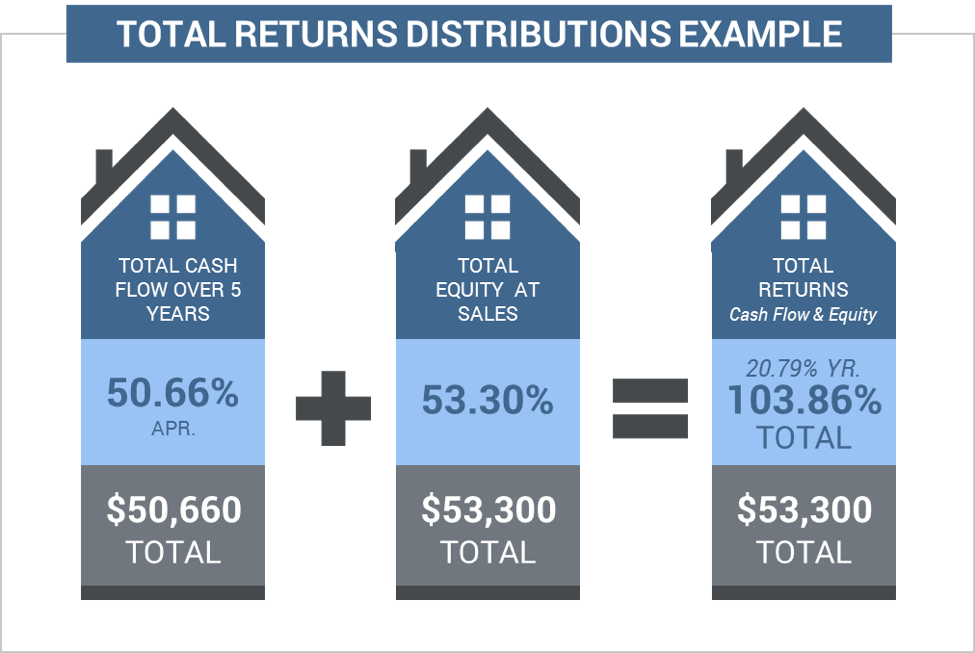
In the final diagram, we will look at the total projected returns on a $100,000 investment from both the cash flow and the equity distributions combined.
Note: The above figures are only an example. Actual returns will vary based on each property.
The example here illustrates the total returns from both cash flow and equity distributions on a $100,000 investment over a 5 year period.
With cash flow and equity distributions combined, the total return to the investor is $103,960. This nets an average return of 20.79% a year.

VALUE ADDING COMPONENTS
1. Depreciation
In the eyes of the IRS, all real estate hypothetically loses value over time due to wear and tear. This is known as depreciation. For an investor, depreciation is a paper loss that can apply against their taxes. Due to depreciation in real estate assets, an investor can lower or eliminate their taxable income.
2. Tax free proceeds from refinancing
Refinancing any real estate allows an investor to take out equity or cash on the property, tax free. If a property grows in value, that value growth can be captured and disbursed to investors with a refinance tax free, unlike capital gains on a property sale.
3. 1031 exchanges
IRC Section 1031 allows investors to postpone paying taxes on any capital gains from a real estate sale if the proceeds are reinvested in a qualifying “like-kind” property within 180 days. This is known as a 1031 exchange, and is a very powerful way to continue acquiring larger investment properties without paying taxes (as long as capital gains are continually reinvested in real estate).
4. Investing through your IRA
Utilizing a self-directed IRA protects investors from paying taxes on the subject investment property income or appreciation until retirement. Self-directed IRAs also enable investors to employ built up retirement funds to invest in multi-family deals, instead of using available cash reserves or liquid funds.
For most people, income tax is a secret wealth killer that consumes a third or more of a person’s total income in life (on average). As such, income taxes represent one of the largest expenses in a person’s life. Having an effective strategy for minimizing or mitigating taxes is therefore critical for an investor who wishes to amass substantial wealth. Compared to the many thousands of investment opportunities available today, real estate investing enjoys some of the best tax advantages ever known. These four tax advantaged strategies for real estate investors can significantly help in lowering your taxes and exponentially growing your investment portfolio.